Overview
The New Orleans Health Department (NOHD) provides free training to middle and high school staff to deliver medically accurate, comprehensive sex education, supporting the health and wellness of adolescents in Louisiana. Trainings and modules cover local health data, state and parish policies, and strategies for creating inclusive classrooms, equipping educators to confidently teach sex education.
Click the link below to access the School-Based Sex Education Interest Form! The form allows schools to indicate interest in participating and includes a link to additional training information.
School-Based Sex Education Training Interest Form: 2025-2026
Program Goals
In New Orleans, there are few external sexual health educators or speakers who can provide comprehensive sex education in schools.
Building in-school capacity is essential to ensure young people gain the knowledge and skills to make informed decisions about their health and relationships.
Sex Education and Health in Louisiana
-
STIs: Louisiana ranks 1st in chlamydia, 3rd in gonorrhea, 4th in HIV, and 8th in syphilis. New Orleans often exceeds the state’s per capita STI rates (CDC, 2022).
Youth Impact: Young people (15–24) account for nearly half of new STI cases (CDC, 2022). While HIV among 15–19-year-olds in New Orleans rose 200% from 2022–2023 (LDH, 2023).
Teen Births: Louisiana has the 3rd highest teen birth rate nationally (CDC, 2022).
References:
Centers for Disease Control: Centers for Disease Control. 2022 STI Surveillance Report. https://www.cdc.gov/std/statistics/2022/tables/2022-STI-Surveillance-State-Ranking-Tables.pdf
Centers for Disease Control. National Overview of STIs, 2022. https://www.cdc.gov/std/statistics/2022/overview.htm
Louisiana Department of Health. STI State Surveillance Data 2023.
Centers for Disease Control. Teen Birth Rates by State, 2022. https://www.cdc.gov/nchs/pressroom/sosmap/teen-births/teenbirths.htm
-
Schools are required to provide instruction on STIs, including HIV, to meet designated grade-level health expectations.
Sex education may be offered but is not mandated, and if it is taught, it must emphasize abstinence, though it does not have to be abstinence-only.
Comprehensive sex education is not required, so topics such as consent, healthy relationships, abortion, and contraceptive distribution may not be included.
Instruction is not required to be medically accurate; it must be based on factual biological or pathological information.
Parents or guardians can opt their children out of sex education classes.
State law permits sex education in grades 7–12 statewide, with a special provision in Orleans Parish allowing it as early as 3rd grades.
References:
Sex Ed for Social Change (SIECUS). (2024, May 8). Louisiana State Profile. https://siecus.org/stateprofiles/louisiana-state-profile-23/
-
A 2018 statewide survey conducted by the Louisiana Public Health Institute and the Institute of Women and Ethnic Studies found that 84% of Louisiana parents and caregivers believe that sex education is a criticalpart of school curriculum and support sex education being required within school settings.
References:
Louisiana Public Health Institute and Institute of Women and Ethnic Studies. Louisiana Parent Survey: What Louisiana Parents Know, Believe, and Perceive about School-Based Sex Education. 2018.
Sex Ed for Social Change (SIECUS). (2024, May 8). Louisiana State Profile. https://siecus.org/stateprofiles/louisiana-state-profile-23/
Sexual Education Facilitator Training
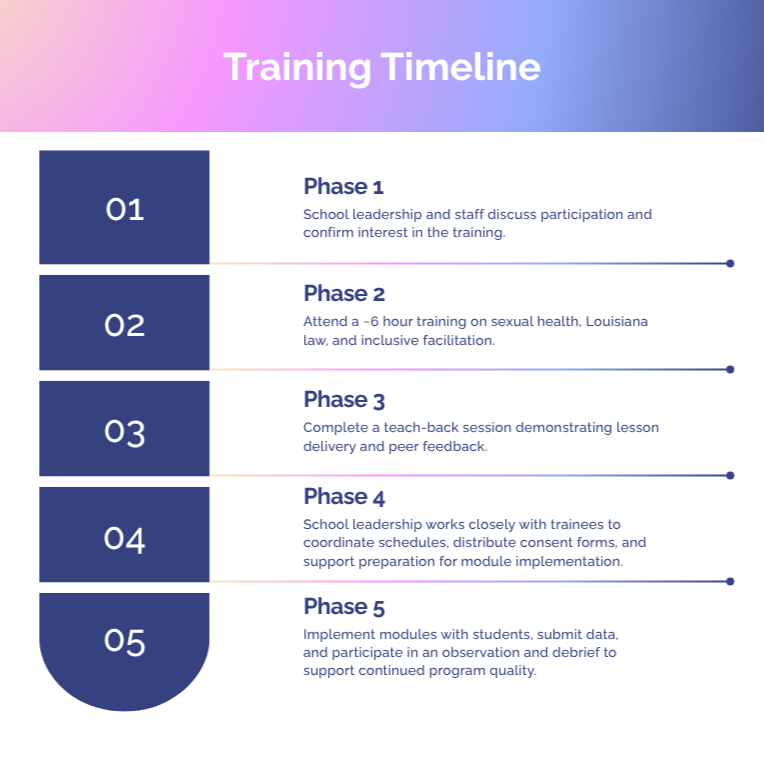
To ensure sexual health modules are taught with accuracy and fidelity, the New Orleans Health Department (NOHD) provides free training for designated school staff. Trainings cover core content knowledge and best practices for values-neutral facilitation of sex education. With leadership approval, health, science, physical education, and advisory teachers in middle and high schools are ideal candidates for this training, as sex education content most often aligns with their courses.
Training Objectives
-
Participants will increase their understanding of sexual health and sex education at both the national and local level and will be able to define sexual health, sex education, and consent. Each module will cover puberty and anatomy, consent and supportive relationships, STIs, and contraceptive care.
-
Participants will examine current Orleans Parish public health data related to sexual and reproductive health and will be able to describe adverse health outcomes with specific understanding of Orleans Parish health rankings.
-
Participants will become familiar with Louisiana state sex education legislation, aligned grade-level expectations, consent laws, mandated reporting, and recent legislation affecting school-based sex education.
-
Participants will develop an understanding of the importance of values-neutral sex education and will build awareness around limiting self-disclosures to provide adolescents with comprehensive, evidence-based sexual health information.
-
Participants will practice responding to sexual health questions using techniques widely used by sexual health educators. These tools will help adults deliver information that is developmentally appropriate, medically accurate, and unbiased.
-
Participants will receive trusted sexual health resources nationally and locally, including a resource guide, sexual health modules, and a facilitator guide to prepare for implementation.
Training Curriculum
Each module takes 45–60 minutes to teach. Complete lesson plans, slides, and resources are provided for easy facilitation. Upon completion of the training, participants will receive the modules and presentation materials directly, allowing them to review the curriculum before implementing lessons.
-
Students will learn medically accurate terminology and gain understanding of the reproductive system
Overview of puberty and associated physical, mental, emotional, and social changes
Health-focused resources for taking care of body and mind during puberty
-
Students will reflect on social-emotional learning skills and relationship value
Define healthy/supportive relationships and unhealthy/unsupportive and associated qualities
Define and discuss importance of consent
Resources to support healthy relationships
-
Students will learn about STIs and modes of transmission
Students will learn about STI prevention, testing, and treatment
Resources will be shared for further information and support
-
Students will learn about various types of birth control including abstinence, condoms, and hormonal methods
Discuss how birth control might support a person’s overall health and goals
Resources will be shared for further information and support
Outcomes
The June and August training sessions engaged 19 participants across 6 charter school networks, representing 3 middle schools and 4 high schools, along with 1 school-based health center team. Community-based and youth-serving organizations also participated, strengthening a collaborative network to support comprehensive sexual health education.

Ryann Martinek, MPH
Ryann Martinek is a sexual health professional with over a decade of experience advancing education, healthcare access, and gender equity across the U.S. and Asia. She earned her Master of Public Health from the University of Washington, where she focused on innovative, app-based approaches to adolescent sexual health education.
In New Orleans, Ryann served as a sexual health educator at the Institute of Women and Ethnic Studies, teaching comprehensive sex education to more than 400 students. She now works as the Sexual and Reproductive Health Specialist at the New Orleans Health Department, leading community-centered initiatives, training, and policy efforts to improve sexual health across the city.
For more information please reach out to Ryann Martinek at ryann.martinek@nola.gov.
Learn more at nola.gov/sexualhealth